
Alger County Court Record Requests
Take an Alger County court record request straight to the court of record rather than a general county office. Before calling anyone, check Alger public case history through MiCOURT Case Search, an informational index of public, indexed matters. Pick the right Alger court before trusting a result. The Alger 93rd District Court keeps traffic, misdemeanor, civil, and small-claims files; the Alger 11th Circuit holds felony, circuit civil, and family-division records; and the Alger Probate Register handles eligible probate and family matters. The Alger clerk controls official inspection and copies under Michigan Court Rule 8.119.
You can request records at the Alger court office, by phone, or by asking the clerk about mail or electronic copy options. Alger offers no court-specific online copy or mail-request form. When you write, give the court, the case number or party name, the record type, the date range, and whether you want a plain copy, a certified copy, a transcript, or inspection. A portal result only points you to the file. The official copy comes from the clerk.
- Identify the Alger court and case type before searching. An Alger 93rd District matter, Alger 11th Circuit matter, and Alger Probate District 5 matter have different custodians.
- Search Alger MiCOURT by public name or case-number fields, then record the selected Alger court and result date.
- Ask the Alger court clerk for Alger public case-history inspection, a plain copy, certified copy, or transcript, using the details located.
- Confirm whether the requested Alger document is public and what reproduction method the Alger court can provide.
- Keep the Alger clerk response with the Alger record request, especially when access is limited or a certified copy is needed.
Note: A public search can point you to the right file. Only the Alger court clerk issues the official record.
Alger Court Clerks by Record
No single Alger County clerk holds every court file. The 93rd District Court staff maintain district criminal, traffic, civil, small-claims, and related records. The Alger 11th Circuit clerk staff keep circuit criminal, felony, general civil, and family-division files. The Alger Probate Register maintains eligible Probate/Family Court records. Alger shares its district and probate systems with Schoolcraft County. The 11th Circuit serves four counties. A county name alone tells you nothing about which office owns a record.
The Alger County staff directory lists public court-office contacts. The county courts landing page shows how Alger court families route. Use the district card for traffic, misdemeanor, civil, and small-claims records. Confirm staff routing before any time-sensitive request. County materials report an Alger Court Administrator/Clerk posting.
Alger 93rd District Court
101 Court Street
Munising, MI 49862
(906) 387-3879
For an 11th Circuit record, follow the Alger Circuit Clerk staff path. For probate or family material, go to the Alger Probate Register. The Alger County Clerk/Register of Deeds plays a separate county-administration and FOIA role, so treat that office as something other than the universal home for Alger court files.
Kinds of Court Records
An Alger County court record is more than the entry list from a case-history search. The docket is just the chronological index. Behind it sit the complaint or petition, summons, proof of service, answer, motions, briefs, exhibits, transcript, order, and judgment. Other filed material sits there too. Whether you can view or copy any item depends on its public status. Any restriction that applies also matters. A public event may name a filing while the document itself stays closed.
- Alger District Court traffic, civil-infraction, misdemeanor, civil, and small-claims case history and filings.
- Alger Circuit Court felony, general civil, appeal, and eligible family-division records.
- Alger Probate materials such as public estate, guardianship, conservatorship, and related filings.
- Alger orders, judgments, proof-of-service records, and docket event histories when public.
- Alger transcript requests, which follow a court reporter or transcript process rather than a standard photocopy request.
Vital records, board records, payment transactions, and Friend of Court service information all run through separate systems.
MiCOURT and Alger Court Records
MiCOURT is the statewide public layer for Alger case history. It is not a stand-in for the clerk's file. The name panel asks for Last Name or Business, First Name, Middle Name, and Birth Year. The case-number panel uses Year, Number, and Type. There is no confirmed Alger case-number pattern or local Type list. Never rebuild a number from a code or a guess. A focused result still helps, because it identifies the clerk to contact for a copy.
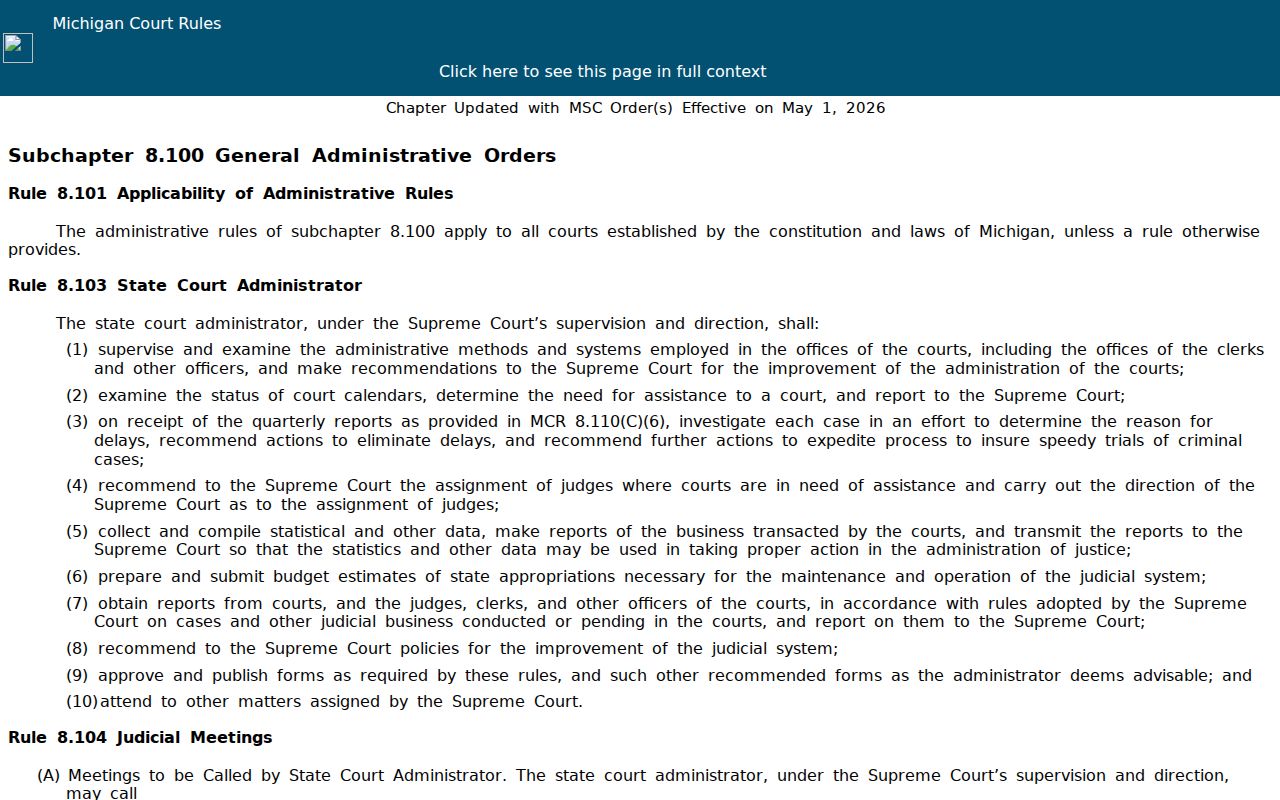
The Michigan Court Rules access material lays out the public-access rule. It governs the case record after a search. That rule separates inspection from reproduction and honors restrictions set by statute, court rule, or order.
For a name or number search workflow before a clerk request, turn to the county's Alger docket search reference. A blank MiCOURT result can mean an excluded category, a wrong court selection, an older filtered record, or a restricted matter. It never proves the court file is absent.
Court Records: What They Contain
Public Alger County court records stack information in layers. The case header comes first. It gives the court, case number, case type, filing date, status, and judicial officer. Party and count fields may add roles, attorneys, service or answer dates, and disposition details. The action and event history tracks filings, settings, motions, orders, and close-case activity. Documents form their own layer. An event label promises nothing about a public, downloadable image.
| Case header | Court, case number, type, filing or open date, status, and assigned judicial officer. |
|---|---|
| Parties and counts | Party role or number, attorney, alternate name, service or answer date, and any public disposition field. |
| Events | Event number, event date, description, associated party or count, clerk entry, comment, judge, and disposition where displayed. |
| Hearings | Hearing type, date, officer, next hearing, and room or location when a public entry supplies those details. |
| Documents | Public complaints, motions, orders, judgments, exhibits, or transcripts only when their access status permits reproduction. |
Alger Court Records Versus FOIA
FOIA is the wrong door for a court file in Alger County. Michigan FOIA leaves court case records outside the ordinary county-record definition. Alger's own FOIA materials send requesters to the court process instead. That process is MCR 8.119. The court clerk handles these requests. Ask to inspect a public docket, pull a filing, or buy a court copy. Save the county FOIA coordinator for administrative material the county actually holds. Think board records, policy files, or a non-case contract.
| Requested item | First route | Why |
|---|---|---|
| 93rd District public case history or filed record | MiCOURT, then District Court clerk | The court record is controlled by MCR 8.119. |
| 11th Circuit public case record | MiCOURT, then Circuit Clerk staff | The court of record controls inspection and official copies. |
| Eligible probate record | MiCOURT if displayed, then Probate Register | Probate and family categories can have separate access limits. |
| County administrative record | County FOIA Coordinator | FOIA applies to county-held administrative records, not a court-file bypass. |
If you need administrative records, Alger County FOIA materials spell out several ways to file. Email goes to foia@algercounty.gov. Fax goes to (906) 387-2156. You can also deliver by mail or in person at 101 Court Street. The county promises an initial response within five business days. One extension of up to 10 additional business days is allowed. Paper copies can run up to $0.10 a sheet. A 50% deposit may be demanded when the estimate tops $50. A written appeal over an administrative record goes to the County Board, which answers within 10 business days. None of that turns a court-copy request into a FOIA matter.
Copy Fees and Certification
Not every copy carries the same weight. A plain copy just reproduces a public record, with no court certification attached. A certified copy is different. The court of record authenticates it, and a downloaded file is never a substitute. Michigan's official access guidance points to $1 per page. It adds $10 for certification under MCL 600.2546. Alger posts no separate court-copy fee schedule, so ask the clerk to confirm the page count and the math before you pay. One more distinction matters. Inspecting a public court record is free under MCR 8.119. Reproduction is charged at actual cost.
| Item | Amount |
|---|---|
| Public court-record inspection | No access fee under MCR 8.119 |
| Plain court copy | Actual reproduction cost, confirmed by the clerk |
| Certified court copy | $1 per page plus $10 certification, subject to clerk confirmation |
| Transcript | Up to $0.90 per page under the state guide; use the transcript process |
Alger Federal Court Records
Federal cases never touch Alger County courts. An Alger-connected federal matter belongs to the U.S. District Court for the Western District of Michigan, Northern Division in Marquette, and runs through PACER or CM/ECF rather than MiCOURT. A state-court search will not surface the federal docket. County FOIA cannot pull a federal court file either. The Western District CM/ECF court information page identifies the federal filing system and the Marquette contact layer, giving case history and documents their own federal route.
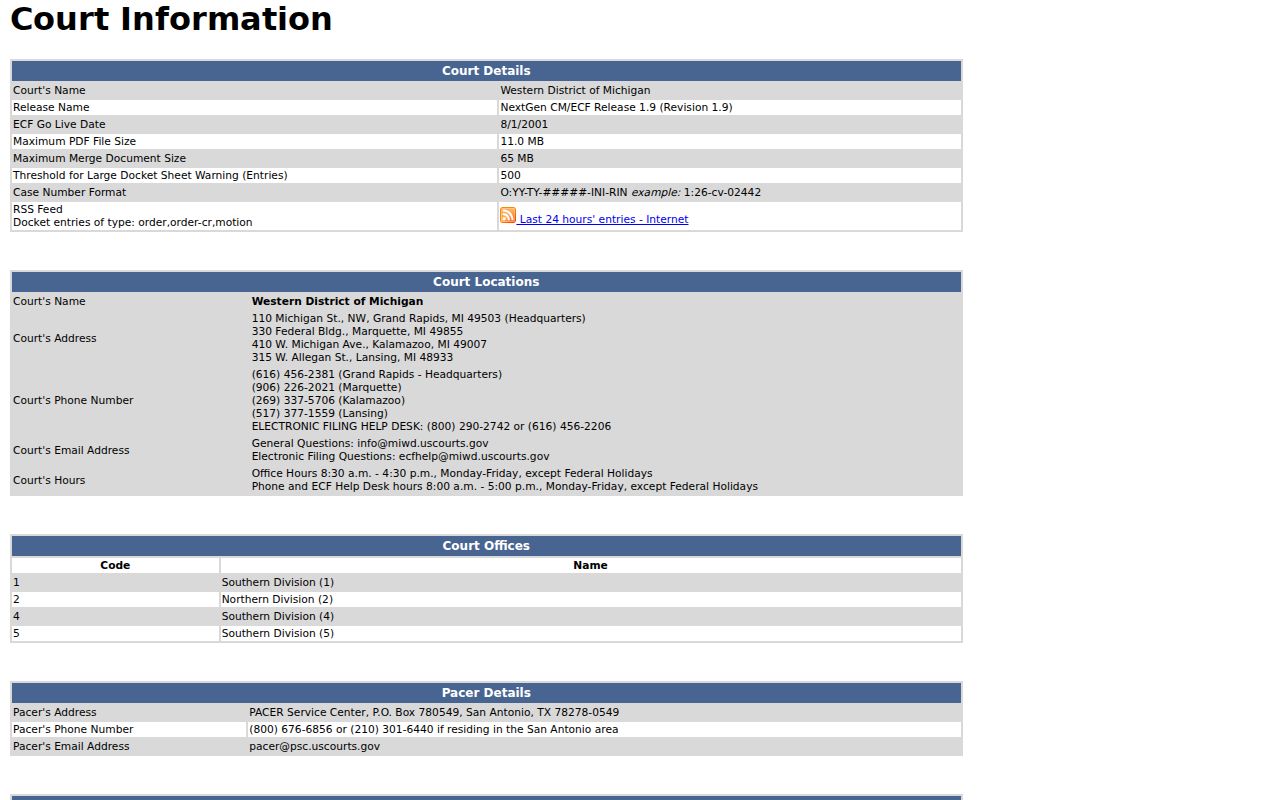
Federal access may require a PACER account and carries separate fee rules. The state-court clerk routes stay exactly the same.
Access Rules for Court Records
Michigan starts from openness. Court records are public unless something specific closes them. Under MCR 8.119, a case record is open unless a statute, court rule, or court order restricts it. So a case caption or public event can sit beside a sealed or nonpublic document. Both can be perfectly proper. When the court cannot hand over a requested item, it should identify the rule or order that controls. Portal access has its own limit. A record appearing in a public portal does not open material reserved for a party or another authorized person.
Key access rules:
MCR 8.119 makes public case records available for inspection while allowing rule, statute, and court-order restrictions.
MCR 1.109 materials identify protected personal identifiers that should not appear in public documents except under rule exceptions.
MCL 712A.28 limits general-public access to juvenile records and provides an authorized court-order path.
When a document is restricted, keep the clerk's response and ask which access rule applies. Here is the trap to avoid. A "no public record exists" answer about nonpublic material does not prove the underlying court matter never existed.
Alger Restricted Court Records
Alger Probate/Family Court work covers juvenile, adoption, PPO, name-change, will, mental-health, and family-related material. MiCOURT never shows that material to the public. MCL 712A.28 is the key juvenile checkpoint. A blank public search should push you to the Probate Register or another court clerk to ask about authorized access. Do not infer there was no case. Family files often mix public procedural history with restricted filings, so parts stay open while the rest stays closed.
- Public record
- A court item available for inspection under the court rules and any applicable local process.
- Restricted record
- A record or document whose access is limited by statute, rule, or court order.
- Sealed record
- A record closed by court authority, even if a related case header or event remains visible.
- Protected identifier
- Information such as a date of birth, Social Security number, state identification number, passport number, or financial-account number protected by MCR 1.109.
Several Alger offices share one address, yet Alger court records stay court-specific. Make the request narrow. Name the correct court, and ask the clerk which access path fits that particular public record.